3 Observations I Made About Grief After I Sliced Off My Finger
 Jewel Busch
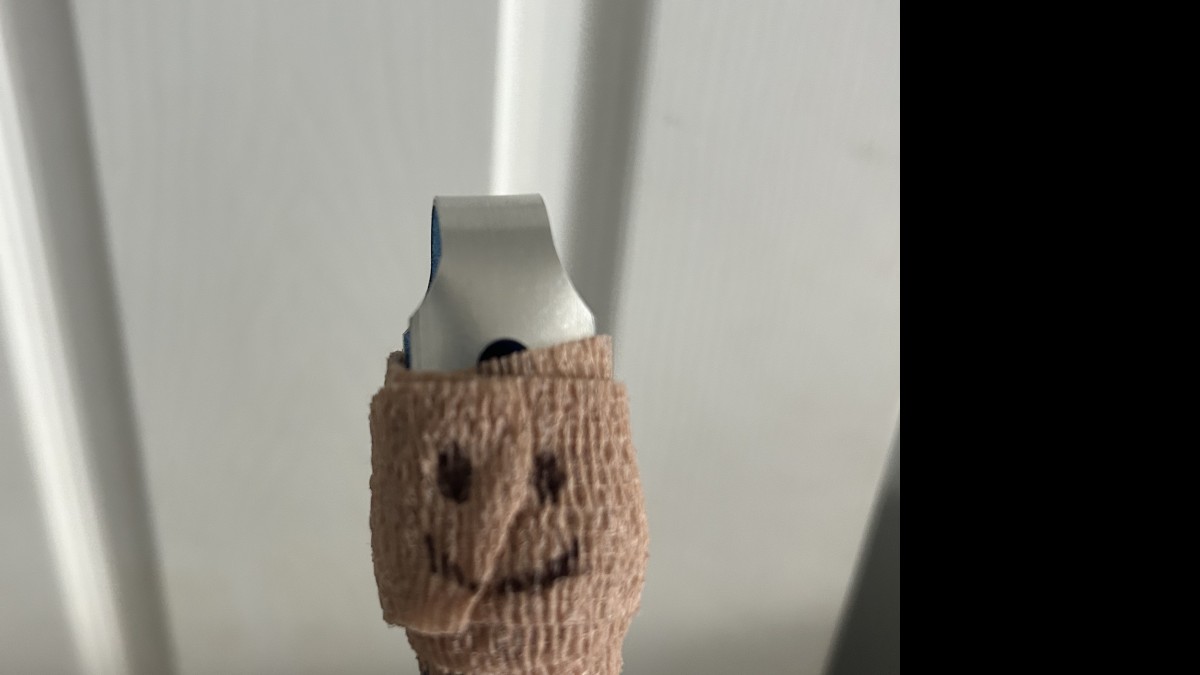
Anyone Know What a Mandolin Slicer is?
I have a ridiculous history of hurting my fingers in significant ways.
When I was 4 years old, I was standing with my right pinky finger tucked in the crack of a metal door that my older sister slammed; it smashed to the point where the doctors were concerned that it might never grow the fingernail back (it did but it's formed differently and a full knuckle's length shorter than my other pinky).
When I was 19, I sliced my left thumb badly on the lid of a can of pineapple; it took several stitches and several years before the thumbnail started growing back normally, but the scar is still visible across my thumbprint.
Three days ago, I used a mandolin slicer for the first time, feeling nervous about slicing myself on it, but resolved to be extra careful. (I didn't notice the available guard my husband had been thoughtful enough to invest in until too late). I managed to get through two cucumbers and the tip off my pointer finger within just a few minutes.
After a couple of hours of trying to get the bleeding to stop at home, Steve finally got me to go to the Walk-in Clinic, where the doctor immediately guessed what had happened (apparently mandolins have a nasty reputation), and was able to get the bleeding stopped and the tip of my finger glued back on within half an hour.
I made three interesting observations about this experience that I wanted to share with you--and don't worry, I won't share any pictures. It's pretty gross-looking.
Observation #1: It's healthy to give yourself (and others) permission to go through the stages of grief over any loss--even the less obvious ones.
Slicing the tip of my finger didn't immediately scream "loss" (other than the loss of half an inch of flesh), but afterwards, I realized that I quickly experienced denial ("It's not that bad--I'm overreacting,"), anger ("That was so stupid! Why wasn't I more careful?"), and bargaining ("If I just hold the ice on it long enough, it'll stop hurting and I'll be fine!"), all within the first fifteen minutes.
It was an urgent, but not emergent situation, and being curious about and naming what I was feeling turned out to be a fascinating exercise. "I'm angry that I made a mistake that's going to take a long time to heal." "This is bringing up a lot of fear and flashbacks from other times I seriously injured my fingers."
I learned that when I shame myself about what I'm feeling with thoughts like "I shouldn't be crying," "It's not a big deal," or "I'm overreacting," everything spiraled much more quickly and overwhelmingly. As soon as I could put words to what I was feeling, even to myself, I was able to breathe more easily.
No, my finger didn't magically heal up, but yes, I felt better about it once my thoughts were more helpful.
Observation #2: Asking for support from the right person can help speed up the healing process.
Because my husband is a medical professional who doesn't mind blood, I FaceTimed him at work immediately to ask his opinion on what I should do with it.
He could tell I was choking back tears, and in between offering some practical advice on actions I could take, he also gently gave me permission to cry if I wanted to.
Guys, I ended up crying for probably 20 minutes.
Not just because of the physical pain, but also because I knew this was going to make everything about my life much harder and more annoying to accomplish. And honestly, it felt SO good to let myself cry for a while--and then get back to finishing dinner one-handed.
When we decided to go to the clinic because we could no longer take care of it on our own, I started feeling light-headed as the doctor was working on my finger, which hurt. A LOT.
I'm usually good with blood, and I was initially embarrassed to ask for help, but I decided to mention that I was feeling dizzy, and he very casually tipped my chair back so I could put my feet up and brought me a juice box to sip. Within moments, I was feeling clear-headed and alert again.
Asking for support can feel scary, especially to those of us who like to identify as self-reliant. But when we're willing to humble ourselves and ask for support from those who are capable of giving it, it opens us up to receiving the heavenly support God wants to give but waits for us to ask for.
Observation #3: With the right training, our brains can be remarkable at adjusting and adapting.
One of the first comments I made at the doctor's office was, "I'm so glad I'm not accompanying any musical numbers." As a pianist, I usually rely on all of my fingers in order to play, and if I was playing for a choir right now, this would have felt paralyzingly difficult to manage.
Ironically enough, the next day, my son sent a text reminder on our family group thread that my 8th grade daughter had choir tryouts scheduled that afternoon.
Guess who her accompanist was supposed to be?
I decided not to panic, knowing that if worst came to worst, we could find a minus track on YouTube or something that we could use. An hour before her audition, I sat down at the piano to see if there was any way I could still play for her, as that had been how she'd practiced, and I didn't want to add any more stress to her first audition experience than was absolutely necessary.
And guess what?
It wasn't perfect, but I was familiar enough with the song that my brain was able to figure out different fingerings that either still hit all the same chords or dropped certain unnecessary notes. It wasn't perfect, but my daughter was able to perform the way she practiced, and she even made callbacks!
It reminded me of when I was learning to speak Mandarin Chinese. I quickly realized that if I didn't yet have the vocabulary for a particular word I wanted to use, I could use other words within my capacity to try to describe what I was trying to say. It was always slower and more cumbersome than using the same phrasing I would've used in my native language, but I eventually learned to get to the goal--communication--even without my first choice available.
If grief or loss has closed a particular door or capacity for a while, rather than focus on what hurts, sometimes it can be helpful to focus on what still is working.
Yes, I have one immobilized finger. A pretty important one, that hurts intensely a lot of the time.
But I also have 9 other fingers that still work wonderfully, and as I've let my brain focus on those, I've been surprised what I've still been able to accomplish.
Grief can sometimes cut painfully and unexpectedly.
When looking at loss, I hope I can always remember these three observations:
1. It's healthy to give myself (and others) permission to go through the stages of grief as many times as needed over any loss--even the less obvious ones.
2. Asking for support from the right person can help speed up the healing process.
3. With the right training, my brain can be remarkable at adjusting and adapting.
The last observation I made was that healing happens, even in the most painful of situations. The first couple of days, my finger was in excruciating pain. Now that it's been a few days, I'm still being careful and less able to do the same things I was able to do before my finger was cut.
I know in a couple of weeks I'll be back to typing with my fingers on the proper keys, playing the songs I'm used to playing, and washing my hands fully without having to keep my index finger dry.
But in the meantime, it's okay that it still hurts.
After all, it was a loss.
A little one, but a loss nonetheless.